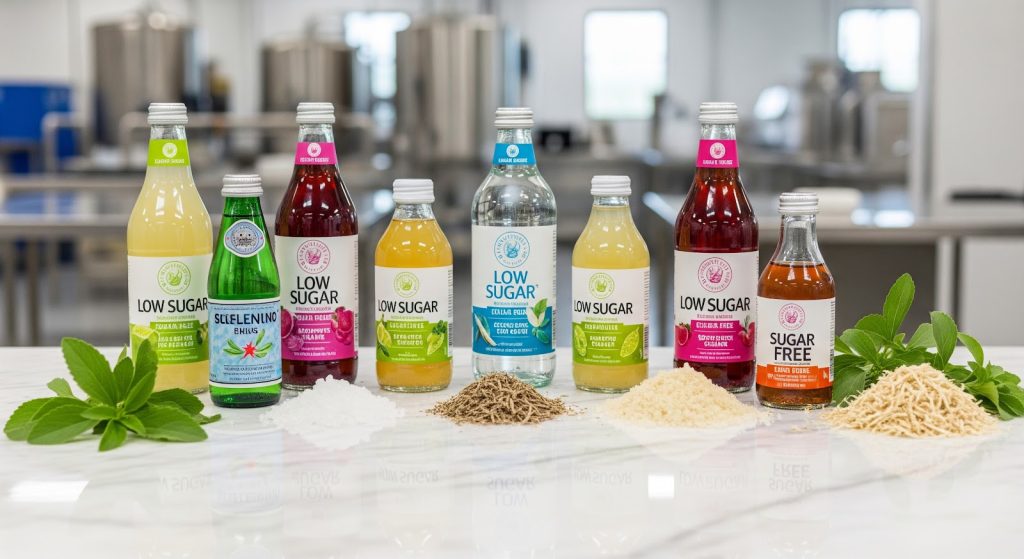
Why sugar reduction is now a priority for beverage brands
The beverage market has changed faster in the last decade than in the previous thirty years.
Health awareness, government policies, and label transparency have forced brands to rethink formulations.
The growing pressure from consumers
Walk through any supermarket and you will notice the shift immediately.
- Consumers are scanning labels.
- They are checking sugar grams.
- They are comparing calories.
Low sugar beverages and sugar free beverages are no longer niche products. They are becoming the standard expectation.
A Nielsen report shows that a majority of global consumers actively try to limit sugar intake. For beverage companies, ignoring this shift is not an option.
Global sugar regulations and taxes
Countries across Europe, Asia, and the Americas have introduced sugar taxes on beverages. These policies directly affect margins and product strategy.
For many brands, beverage reformulation for sugar reduction is no longer a marketing choice. It is a financial necessity.
The science of sweetness in beverages
Reducing sugar is not as simple as removing a few grams.
Sugar plays multiple roles inside a beverage system.
Sugar does more than sweeten
Sugar contributes to
- Mouthfeel
- Flavor release
- Acidity balance
- Body and viscosity
Think of sugar like the foundation of a house. Remove it and everything sitting on top becomes unstable.
The sweetness perception curve
Human taste perception is complex.
Some sweeteners hit quickly but disappear fast. Others build slowly. Some create bitterness.
This is why replacing sugar with a single ingredient rarely works.
Smart formulators build sweetness like a musical chord rather than a single note.
Common mistakes brands make during sugar reduction
Many companies rush into reformulation and learn painful lessons.
Cutting sugar without replacing functionality
Removing sugar without adding texture solutions results in thin, unbalanced beverages.
Consumers may not know what changed but they instantly know something is wrong.
Overusing artificial sweeteners
Another mistake is relying heavily on one high intensity sweetener.
This often creates metallic or lingering aftertastes that destroy product acceptance.
A better approach involves combining multiple ingredients that mimic sugar more naturally.
Smart sugar reduction strategies for beverages
Let us look at what actually works in commercial beverage development.
Gradual sugar reduction strategy
Consumers adapt surprisingly well to gradual changes.
Many successful beverage brands reduce sugar step by step across product updates instead of drastic cuts.
This approach protects brand loyalty.
Sweetness layering approach
Instead of one sweetener, modern formulations combine
- Natural sweeteners
- Rare sugars
- Functional fibers
This layered approach delivers a rounder taste profile.
Flavor enhancement techniques
Flavor modulators, acids, and aroma compounds can amplify perceived sweetness even when actual sugar content is lower.
This technique is widely used in successful sugar reduction strategies for beverages.
Next generation ingredients that solve the sugar problem
Ingredient innovation is the real hero behind successful low sugar beverages.
At 1-2-Taste, we work closely with beverage companies to identify ingredients that preserve taste while significantly reducing sugar levels.
Here are three solutions that are gaining strong traction with R&D teams.
Optimized stevia solutions
Stevia has long been known as a natural sweetener, but earlier generations struggled with bitterness.
Newer optimized extracts such as
AudinaSweet Optimized Stevia AG3240
offer a cleaner taste profile and improved sugar like sweetness.
This ingredient helps brands reduce sugar without losing sweetness while maintaining a natural positioning.
You can explore it here
Allulose as a sugar alternative
Allulose is one of the most exciting rare sugars available today.
It behaves very similarly to sugar in beverages but delivers significantly fewer calories.
Benefits include
- Sugar like taste
- Excellent solubility
- No sharp aftertaste
- Suitable for low sugar beverages
Many brands now use Allsweet Allulose Crystalline Powder to reformulate drinks while keeping consumer satisfaction high.
Product details here
Functional fibers for mouthfeel
When sugar disappears, body often disappears with it.
That is where functional fibers come in.
FiberSmart Soluble Tapioca Fiber Syrup helps restore
- Mouthfeel
- Texture
- Mild sweetness
- Stability
This ingredient is extremely valuable in beverage reformulation for sugar reduction.
Explore the ingredient here
Together, these ingredients allow beverage brands to build sweetness systems instead of relying on sugar alone.
Beverage reformulation case examples
Let us look at how different beverage categories apply sugar reduction.
Carbonated beverages
Carbonated drinks rely heavily on sweetness balance.
A common reformulation approach combines
- Stevia for sweetness
- Allulose for body
- Fiber for mouthfeel
This allows significant sugar reduction in beverages without affecting drinkability.
Functional drinks and teas
Health focused drinks often benefit from natural positioning.
Stevia combined with light fruit sweetness works well in this category.
Dairy and plant beverages
Milk based drinks require careful balance.
Fibers and rare sugars help recreate the creamy texture that sugar usually provides.
The future of low sugar beverages
The direction of the beverage market is clear.
Lower sugar will become the baseline expectation.
But taste will remain king.
Brands that succeed will not simply remove sugar. They will redesign sweetness using smart ingredient systems.
This is where collaboration between R&D teams and ingredient partners becomes powerful.
At 1-2-Taste, our goal is simple.
Help beverage innovators build drinks consumers love while solving the sugar challenge.